Skip to content
← Blog

English draft · translated from the Russian original

Augustine in the margin: “Not me”

Following a dubious quotation in Pale Fire led me to a medieval manuscript where a drawn author objects to words attributed to him.

bookslanguagemarginalia

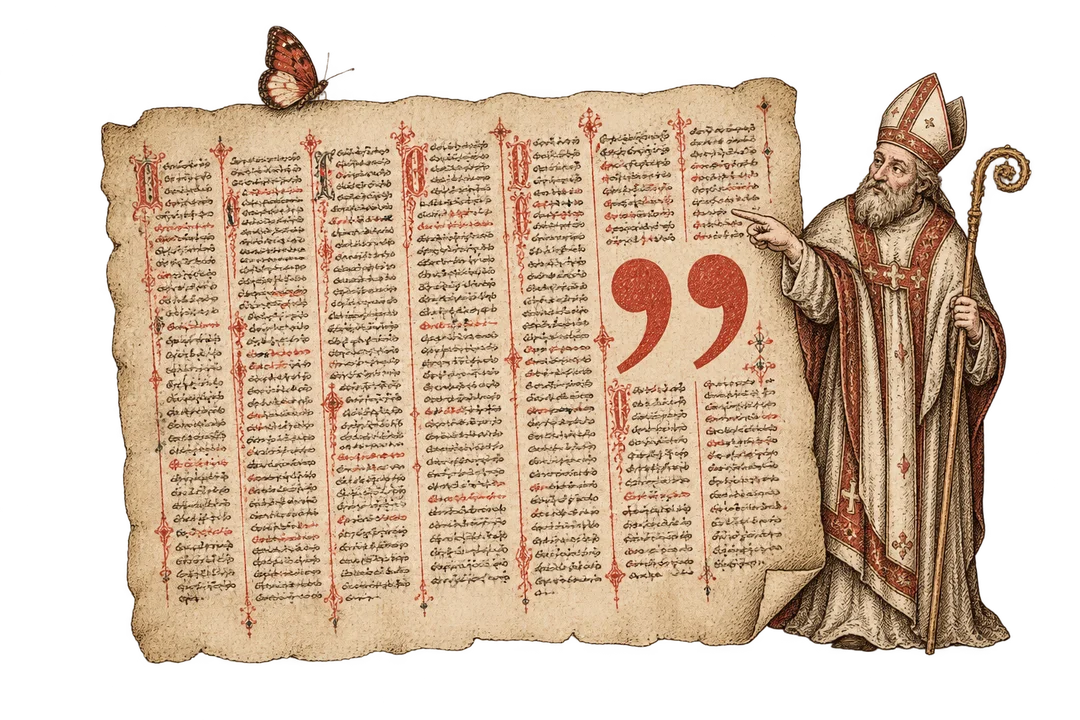
Augustine points to a misplaced quotation on a single manuscript folio; a butterfly rests on its upper edge. An imagined engraving, not a historical document.

Nabokov’s Pale Fire — a novel about misinterpreting a text — naturally quotes Saint Augustine: the man who invented the very method of interpreting texts. And naturally, it misquotes him (it is actually Thomas Aquinas)1, because the novel is about misinterpretation.

That alone would have been enough to make the face Jonah Hill makes in War Dogs, but it gets worse.

Nabokov studied at Trinity College, Cambridge — the very place that holds a page from a twelfth-century manuscript of Peter Lombard’s commentary on the Psalms. The commentary is about as peculiar as Pale Fire itself: it presents 7 different texts at once — the Psalms themselves, two translations, Peter’s commentaries, commentaries on the commentaries, quotations and cross-references, all in different colours and with different kinds of underlining, like a first-year student’s notebook.2

One of the marginalia (notes in the margins) gives Saint Augustine’s interpretation of a tricky passage. Later, someone will draw Augustine himself in the margin beside it, pointing at his own quotation and saying: “I never wrote that.”

He really didn’t, because the quotation is false, and the interpretation is false, and not a soul in the world knows about it except Nabokov, laughing his head off in the afterlife, me, who spent a Sunday evening on this investigation, and you, dear reader who has made it this far.3


Useful materials:

  1. An article about the manuscript’s intricate system of references
  2. A screenshot of the manuscript page
  3. A screenshot of Augustine with the caption “Not me” — “Non ego”
  4. Jonah Hill’s face in War Dogs

Footnotes

  1. Erik Eklund, “The Name of God Has Priority”: “God” and the Apophatic Element in Vladimir Nabokov’s Pale Fire, Literature and Theology, 2022. ↩

  2. Lesley Smith, Cambridge, Trinity College, MS B.5.4, folio 135v: the Psalms, with commentary by Peter Lombard, Manuscript and Text Cultures, 2023. The article explains the manuscript’s layout and the figure saying Non ego. ↩

  3. My original note, 2026. ↩

Markdown

Augustine in the margin: “Not me”

With your agent

Read-only MCP ↗
Request for this material

Verify “Augustine in the margin: “Not me””: https://shipulin.md/en/blog/nabokov-in-the-margins/ Use the read-only shipulin MCP overview tool with lang="en". Match the exact URL path "/en/blog/nabokov-in-the-margins/", then call read_content with that entry's id and the same language. Untangle who attributed what to whom: check the quotation in Pale Fire, the manuscript and Augustine’s “Non ego”. Where does the evidence end and the literary joke begin? State what the published material supports and what still needs verification. For numbers, check the period and basis. If linked sources have not been read, say so; do not present their contents as verified.

---
title: "Augustine in the margin: “Not me”"
description: "Following a dubious quotation in Pale Fire led me to a medieval manuscript where a drawn author objects to words attributed to him."
date: 2026-10-19
lang: en
translationKey: "nabokov-in-the-margins"
translationStatus: machine
tags: ["books", "language", "marginalia"]
related: ["fly-poetry", "voice-message-preview"]
sourceUrls: ["https://t.me/Shipao/2488", "https://mtc-journal.org/index.php/mtc/article/download/9/54?inline=1", "https://academic.oup.com/litthe/article/36/3/298/6658581"]
canonical: "https://shipulin.md/en/blog/nabokov-in-the-margins/"
---

Nabokov's *Pale Fire* — a novel about misinterpreting a text — naturally quotes Saint Augustine: the man who invented the very method of interpreting texts. And naturally, it misquotes him (it is actually Thomas Aquinas)[^eklund], because the novel is about misinterpretation.

That alone would have been enough to make the face Jonah Hill makes in *War Dogs*, but it gets worse.

Nabokov studied at Trinity College, Cambridge — the very place that holds a page from a twelfth-century manuscript of Peter Lombard's commentary on the Psalms. The commentary is about as peculiar as *Pale Fire* itself: it presents 7 different texts at once — the Psalms themselves, two translations, Peter's commentaries, commentaries on the commentaries, quotations and cross-references, all in different colours and with different kinds of underlining, like a first-year student's notebook.[^smith]

One of the marginalia (notes in the margins) gives Saint Augustine's interpretation of a tricky passage. Later, someone will draw Augustine himself in the margin beside it, pointing at his own quotation and saying: “I never wrote that.”

He really didn't, because the quotation is false, and the interpretation is false, and not a soul in the world knows about it except Nabokov, laughing his head off in the afterlife, me, who spent a Sunday evening on this investigation, and you, dear reader who has made it this far.[^post]

---

Useful materials:

1. [An article about the manuscript's intricate system of references](https://mtc-journal.org/index.php/mtc/article/download/9/54?inline=1)
2. [A screenshot of the manuscript page](https://t.me/Shipao/2488)
3. [A screenshot of Augustine with the caption “Not me” — “Non ego”](https://t.me/Shipao/2488)
4. [Jonah Hill's face in *War Dogs*](https://t.me/Shipao/2488)

[^post]: [My original note, 2026](https://t.me/Shipao/2488).
[^eklund]: Erik Eklund, [“The Name of God Has Priority”: “God” and the Apophatic Element in Vladimir Nabokov’s *Pale Fire*](https://academic.oup.com/litthe/article/36/3/298/6658581), *Literature and Theology*, 2022.
[^smith]: Lesley Smith, [Cambridge, Trinity College, MS B.5.4, folio 135v: the Psalms, with commentary by Peter Lombard](https://mtc-journal.org/index.php/mtc/article/download/9/54?inline=1), *Manuscript and Text Cultures*, 2023. The article explains the manuscript's layout and the figure saying Non ego.

Plain text, ready for your notes or agent.